Categories
journals news work

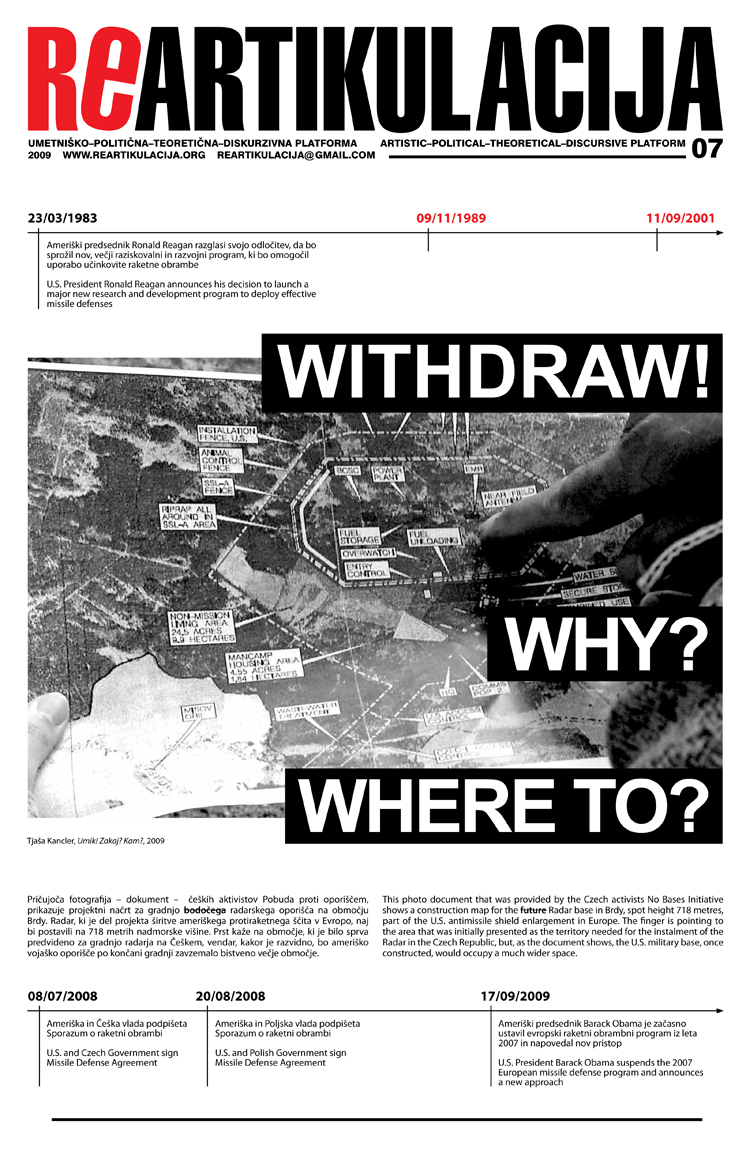
Reartikulacija #7

Reartikulacija is an art project of the group Reartikulacija (Marina Gržinić, Staš Kleindienst, Sebastjan Leban and Tanja Passoni). It is based on a precise intervention logic; through contemporary political theory, critic, art projects, activism and selforganization, it aims to intervene in the Slovene, Balkan and international space. The platform allows networking with other political subjects, activists, artists, who are interested in the possibility to create and maintain a dialogue with concrete social and political spaces in Slovenia, Europe and worldwide…
Categories
journals news

#18: Critique and Truth

Chto Delat?, http://www.chtodelat.org

Dusan Grlja and Jelena Vesic (Prelom kolektiv) /// The Neo-liberal Institution of Culture and the Critique of Culturalization

The activities of Prelom kolektiv involve the making and editing of Prelom journal, organizing exhibitions, conferences and discussions, and participating in other artistic and cultural projects and events [1]. In a terminology often used today, this makes us “cultural workers” or even so-called “content providers” for the expanding “cultural industries” within the neo-liberal capitalist system. Although we oppose this kind of positioning and the whole constellation that produces it, this is precisely the starting point for an objective, i.e. materialist understanding of what the institution of culture is today.

Categories
journals news

#01- 25: What is the use of art?

Chto Delat?, http://www.chtodelat.org

Devin Fore /// Soviet Factography: Production Art in an Information Age

Any discussion of factography first has to deal with the conspicuous strangeness of the word “factography” itself, an awkward and selfconsciously technicist term coined in Russia in the latter half of the 1920s to designate a certain aesthetic practice preoccupied with the inscription of facts. Those who are familiar with contemporaneous avant-garde movements in other countries and who may also be skeptical of the early Soviet zeal for linguistic invention will wonder if factography is not simply another word for documentary.

Categories
journals

e-borderlands journal

We wish to think in the spaces between disciplines, their borderlands, so as to challenge the framing and disciplining of knowledge within modernity. We wish to promote and support new forms of writing which blur the lines between fiction, journalism, and essayistic prose. And politically, we feel that the issue of borders – between nations, sexualities, economies, identities and peoples – brings together some of the most pressing issues in the 21st century, issues which drive violence and conflict, mark out profound dilemmas over power, sovereignty and autonomy under globalisation, and remain central to the question of whether we can continue to live together and survive.

Categories
articles journals news

Towards Planetary Decolonial Feminisms

The title of this dossier honors the social activism and political philosophy of the coalitional project of decolonial feminisms. While those involved in this conversation have for the most part been located in geographical spaces regularly referred to as the United States and Latin America (particularly Bolivia and Mexico), the central question that motivates our solidarity—what does it mean, as Laura Pérez writes in her essay here, “to engage in decolonizing coalitions that take feminist queer of color critical thought seriously as central to the work of decolonization?”—is one that is necessarily posed between and beyond these reified time-spaces. The contributions to feminist thinking made in this dossier by scholar-activists working in and across the contexts of Bolivia, the United States, Korea, Japan, India, and France can perhaps best be understood as moving between the “post” and the “de” colonial; beyond the reification of our globe toward a version of what Gayatri Spivak has named planetarity.1