at Weltmuseum Wien 8 October 2020 to 3 April 2021 The exhibition Stories of Traumatic Pasts: Counter-Archives for Future Memories focuses on three European regions, their stories, and their current experiences of collective amnesia in relation to traumatic events from the past: Belgian colonial rule in the Congo, Austria after the “Anschluss” in 1938, […]
Category: books
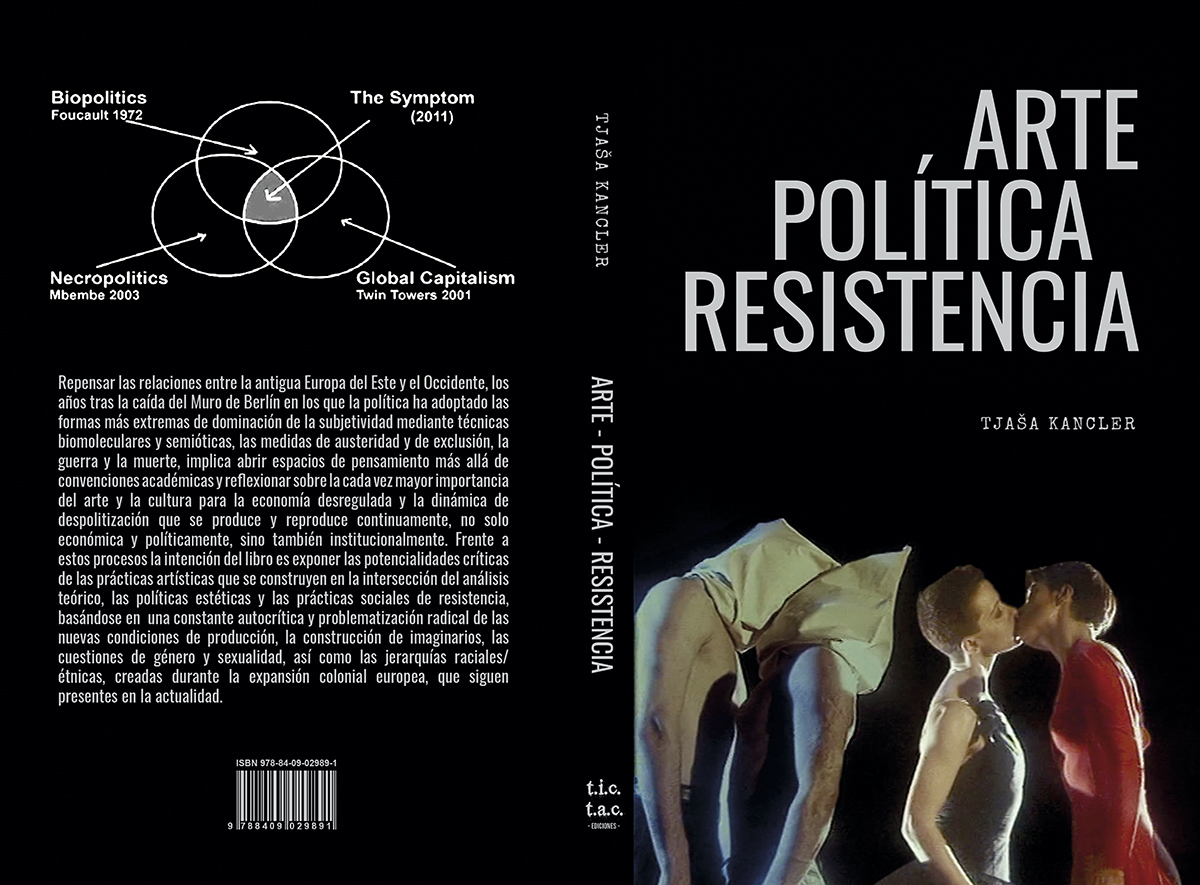
Tjaša Kancler
1a ed. – Barcelona: Ediciones t.i.c.t.a.c., 2018
Repensar las relaciones entre la antigua Europa del Este y el Occidente, los años tras la caída del Muro de Berlín en los que la política ha adoptado las formas más extremas de dominación de la subjetividad mediante técnicas biomoleculares y semióticas, las medidas de austeridad y de exclusión, la guerra y la muerte, implica abrir espacios de pensamiento más allá de convenciones académicas y reflexionar sobre la cada vez mayor importancia del arte y la cultura para la economía desregulada y la dinámica de despolitización que se produce y reproduce continuamente, no solo económica y políticamente, sino también institucionalmente.[…]

Marina Gržinić (Ed.) With contributions by Ilya Budraitskis, Maira Enesi Caixeta, C.A.S.I.T.A., Yuderkys Espinosa Miñoso, Miguel González Cabezas, Marina Gržinić, Juan Guardiola, Çetin Gürer, Neda Hosseinyar, Njideka Stephanie Iroh, Adla Isanović, Fieke Jansen, Tjaša Kancler, Zoltán Kékesi, Betül Seyma Küpeli, Gergana Mineva, Musawenkosi Ndlovu, Stanimir Panayotov, Suvendrini Perera, Jelena Petrović, Khaled Ramadan, Rubia Salgado, Marika […]
Editors: Sandeep Bakshi (University of Le Havre), Suhraiya Jivraj (University of Kent) and
Silvia Posocco (Birkbeck, University of London)
Counterpress, Oxford, 2016
Decolonizing Sexualities: Transnational Perspectives, Critical Interventions contributes to the critical field of queer decolonial studies by demonstrating how sexuality, race, gender and religion intersect transnationally. The volume maps some of the specifically local issues as well as the common ones affecting queer/trans people of colour (qtpoc). The contributions are not delimited by traditional academic style but rather draw on creative inspiration to produce knowledge and insight through various styles and formats, including poetry, essays, statements, manifestos, as well as academic mash-ups. Queering coloniality and the epistemic categories that classify people means to disobey and delink from the coloniality of knowledge and of being. At this intersection, decolonial queerness is necessary not only to resist coloniality but, above all, to re-exist and re-emerge decolonially.
Bojan Bilić (ed.)
Palgrave Macmillan UK, 2016
Europe and the European Union are unavoidable, if ambiguous, political references in the post-Yugoslav space. This volume interrogates the forms and implications of the increasingly potent symbolic nexus that has developed between non-heterosexual sexualities, LGBT activism(s) and Europeanisation(s) in all of the Yugoslav successor states.
Contributors to this book show how the long EU accession process disseminates discursive tools employed in LGBT activist struggles for human rights and equality. This creates a linkage between “Europeanness” and “gay emancipation” which elevates certain forms of gay activist engagement and perhaps also non-heterosexuality, more generally, to a measure of democracy, progress and modernity. At the same time, it relegates practices of intolerance to the LGBT community to the status of non-European primitivist Other who is inevitably positioned in the patriarchal past that should be left behind.